

Ali Nadeem Rezavi
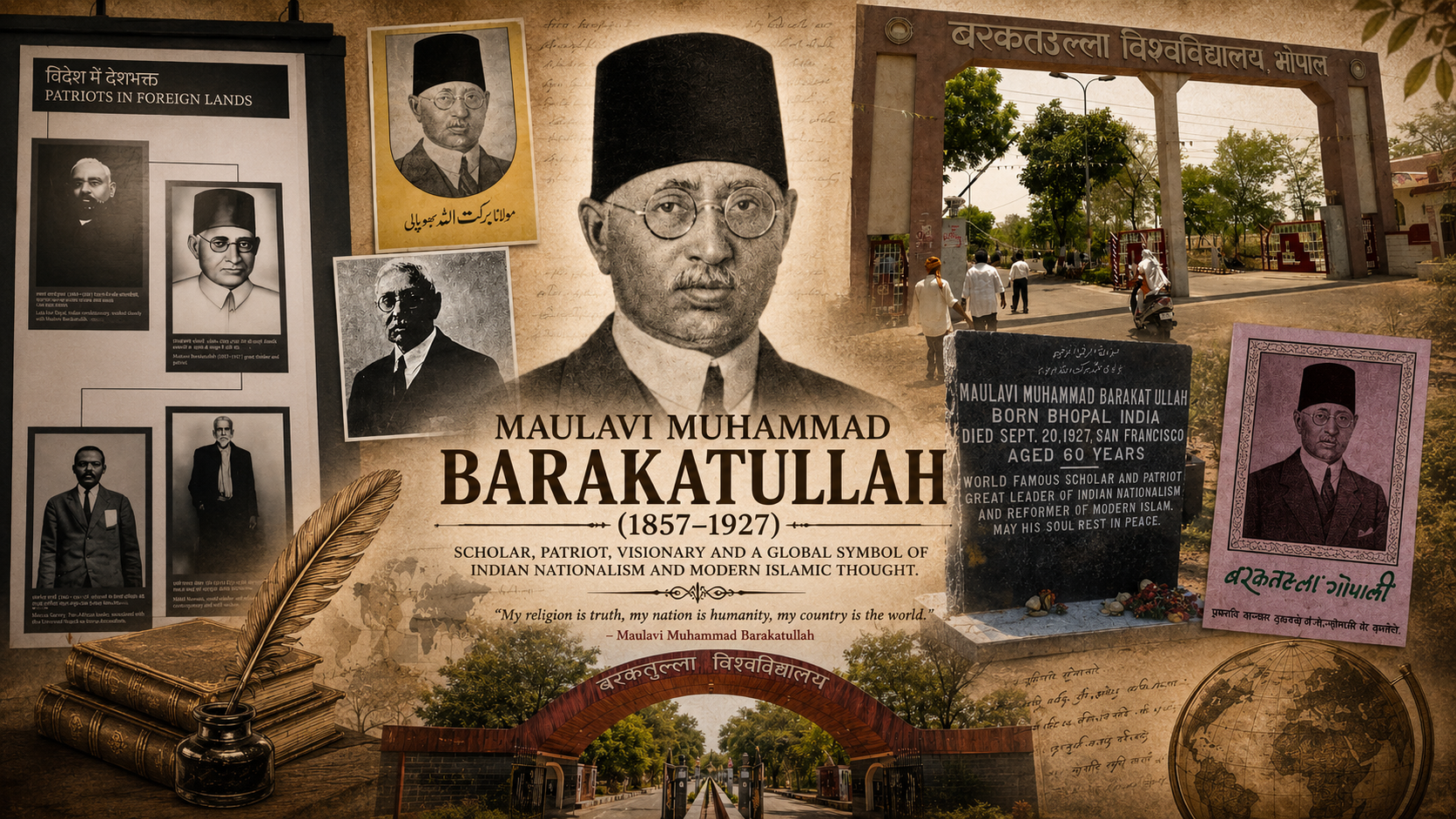
The idea of changing the name of Barkatullah University in Bhopal might sound like a small administrative matter, but it is much more than that. It touches on something deeper: how India chooses to remember its freedom fighters and what values we want to pass on to the next generation. Today, when public institutions are often caught up in political fights, trying to remove Maulana Barkatullah Bhopali’s name from the university feels less like a thoughtful review of history and more like an act of division. To understand why the name must stay, we first need to know who Maulana Barkatullah really was. He was born in Bhopal on July 7, 1854. As a child, he learned Arabic, Persian, and English, but his life took him far beyond the classroom. He traveled across Asia, Europe, and North America, always with one mission: to free India from British rule. Unlike many freedom fighters who worked from inside the country, Barkatullah spent most of his life in exile. Being away from home never weakened his love for India. He connected with anti-colonial movements around the world and became one of the most well-known Indian revolutionaries of his time. Inspired by resistance efforts in the Muslim world, he believed that justice was a global cause and that India’s freedom was part of that larger fight.
What makes Barkatullah special is his strong belief that India could only be free if all its communities stood together. He worked closely with Hindus, Muslims, Sikhs, and people from every region. The best example of this is the Provisional Government of India set up in Kabul in 1915. Along with Raja Mahendra Pratap, a Hindu prince, and Maulana Ubaidullah Sindhi, a great Islamic thinker, he formed a government in exile. Raja Mahendra Pratap became President, and Barkatullah became Prime Minister. This was one of the first times Indians had set up their own independent political body outside British control. This story is important not just because it challenged the British but because it showed a vision of India where people of different faiths fought side by side for a common goal. Long before we started talking about secularism in textbooks, Barkatullah and his friends lived it. They proved that the fight against colonialism needed love and trust between all communities.
Barkatullah gave up comfort, family, and the safety of home. He never got to return to India. He died in exile in the United States on September 20, 1927, never seeing the free India he had worked so hard for. It is said that his last words were not bitter or sad; he only regretted that he would not see a free India, but he was sure that future generations would finish what he and his comrades had started. That is why naming the university after him was not a small or sectarian gesture; it was a genuine thank you from the nation. The name “Barkatullah University” honors not just one man but a whole tradition of sacrifice, cross-border work, and Hindu-Muslim unity in the freedom struggle.
If we remove his name today, we send a troubling message. It would seem that we no longer judge a freedom fighter by what he did for the country but by his religion. That would be a shallow and unfair way to look at our own history. India’s freedom movement was strong precisely because it included people of every faith, language, caste, and region. To erase Barkatullah is to erase that richness. For decades, thousands of young men and women have graduated from here, saying with pride, “I am from Barkatullah University.” The name is woven into their memories of late-night studies, friendships, and dreams of a better future. Changing the name would rip apart that shared feeling of belonging and would feel like a loss not just of a name but of a part of their own identity.
A confident nation does not erase its heroes; it remembers them, even when that memory feels uncomfortable to some. Preserving the name of Maulana Barkatullah Bhopali means preserving a vital part of India’s history: a history of resistance, unity, and an inclusive dream of nationhood. Think of the other freedom fighters we have honored across India, regardless of their religion: Bhagat Singh, Subhas Chandra Bose, Ashfaqulla Khan, and Maulana Abul Kalam Azad. No one has suggested removing their names from public places. To single out Barkatullah would not be historical correction; it would be historical exclusion, and that is not something a fair-minded country should do.
Barkatullah University must remain Barkatullah University because names matter. They carry stories and teach us who we are. His story tells us that India belongs equally to everyone who loves it.