
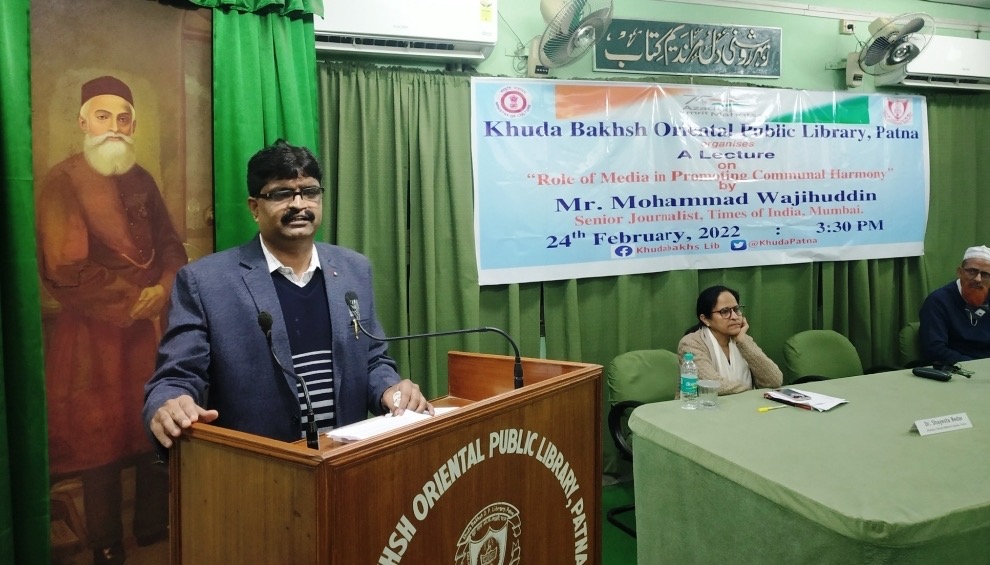

By Mohammed Wajihuddin
Khincho na kamanon ko na talwar nikalo
Jab top muqabil ho toh akhbar nikalo
The great satirist-poet Akbar Allahabadi who penned this memorable couplet lived in a different era. Was he to return to this earth today, he would be shocked to see that the newspapers that he likened to lethal weapons have substantially been weakened? However, for all its weaknesses, newspapers and other media platforms for that matter, still command some respect.
Since media mirrors our society, it undeniably has many roles to play. It is lifeblood of democracy.
One of the roles of media is to peace and harmony among communities. For a multi-religious, multi-cultural society like India, media plays a critical function in establishing peace.
Media is famously called a watchdog, because a watchdog never bites its owner. So the question arises: Who owns the media. It is the readers. Corporate houses maybe running the media business, but the biggest stakeholders are the readers who patronize the papers or the channels. No media house can survive if it doesn’t cater to the readers, its audience.
There was a time when running a newspaper was a mission. So, many of our freedom fighters, including Gandhi, Nehru, Maulana Azad, Maulana Mohammad Ali, Hasrat Mohani, and Bal Gangadhar Tilak before them, had their own publications. Fired by the zeal to get India free from the British yoke, these patriots used their publications to motivate the masses to join the satyagrah for a free India.
Many revolutionaries used their publications to ignite the hope among Indians of a better future. His peaceniks among politicians of the pre-independent era used the pages of their own publications and other newspapers and journals to douse the fire of communalism during the Holocaust of partition. Through articles, essays and poems they sang paeans to Hindu-Muslim University. Communal harmony became not just their credo but part of their faith system.
Media can make or mar the destiny of a nation, they say. Media outlets not just give news; they also shape opinion and help people take informed decision. Media helps make the perception too. If a huge chunk of media dishes out negative things about a country or people day in and day out, you start believing it. When media becomes propaganda machine of a particular group of people or their ideology, it harms peace and harmony.
Several enquiry commissions set up to probe communal riots, especially in post-partition India, found a section of media fanning the flames of communalism.
I reached Mumbai when the Sri Krishna Commission which had probed the post-Babri demolition riots in Mumbai pulled up a particular daily newspaper edited by a big political leader who is no more. The vitriolic and vituperative statements that particular daily carried stirred the communal cauldron. Instead of dousing flames, the paper provoked the people and justified mob violence.
However, there was another paper, the weekly tabloid Blitz of Russi Karanjia, which tried to calm the nerves. Let us stay a little longer with Blitz. This tabloid was famous was investigative journalism and was a trailblazer. I would read Blitz regularly at Curzon Reading Room of this historic library in the early 1990s before I moved to Delhi and then Mumbai. M J Akbar whose Asian Age became a springboard for me tried to revive Blitz. But times had changed. Karanjia was old and ailing while filmmaker, author and columnist Khwaja Ahmed Abbas had been dead for years. Blitz couldn’t be given a fresh lease of life. It finally closed down. The death of once staunchly secular papers like Blitz and Current proved to be a big loss for both secularism and communal harmony in India.
I came into journalism in an era when attempts had been made to widen the Gulf between communities. When I decided to leave Delhi for Mumbai in 1995, there were friends who tried to stop me by scaring that a big, strange city might kill me. The wounds of the communal violence had not healed completely. But I had resolved to find my feet in journalism in that big, strange city. Doors do open to those who have courage to face challenges. It happened with me too.
So, what has changed in journalism in the last two decades? A lot. Now social media has taken the lead. It is giving a big competition to the traditional media. In rush to catch up with the fast social media, sensationalism has become a rule rather than an exception. The task of promoting communal harmony does get affected due to TRP-seeking, sensationalist media. Sometime minor incidents are blown out of proportion and good, hard news get neglected. The unsavory phenomenon of paid news, fake news and godi media does derail the task of nation-building and maintaining peace and harmony in society.
But all is not lost yet. The fact that we have institutions like Khuda Bakhsh Library which, apart from attracting scholars from across the world, regularly holds talks and discussions on subjects that concern us all. Media might have lost some of its respect, but it still plays the role of a guide. It still upholds humanitarian values. It still reminds us of our celebrated sajhi virasat, our Ganga-Jamuni tehzeeb, the famed composite culture. A section of media may have sold out their soul, but we do have those players who still have their conscience intact. These media people are committed to the cause and work tirelessly to fight communalist and sectarian views. They work as bull work against negative forces. We need to encourage our new generation to make career in media and journalism. We need to nurture talents.
And as long as those sentinels of sanity and sanctuaries of peace amidst us exist, our faith in media will remain unshaken. And humble prn pusher like me will keep reaffirming faith in fair, fearless journalism. The media’s work as promoter of communal harmony will continue.
(The author is a senior journalist with The Times of India, Mumbai).