

Why is INDIA’s decision to boycott anchors politically immature?
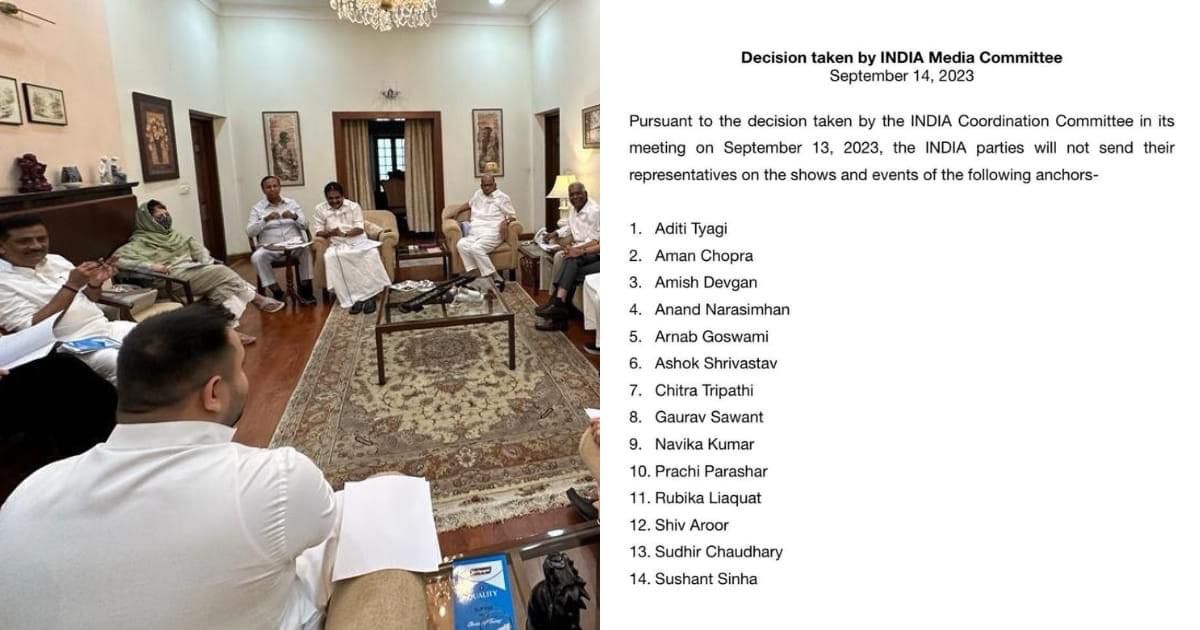
On Thursday, the Indian National Developmental Inclusive Alliance (INDIA) released a list of 14 television anchors/journalists saying “the INDIA parties will not send their representatives on the shows and events of” these 14 anchors.
The supporters of INDIA are hailing the decision as an important step towards combating hate as they believe that shows of these 14 anchors are spreading hate, especially anti-Muslim, in the Indian society. A criticism which is coming from within the supporters of INDIA is that the list is too short and misses out on several prominent names of Godi media (a name popularised by former NDTV anchor Ravish Kumar for the anchors who praise BJP and Narendra Modi).
We need not mention that BJP supporters are criticising this step as an attack on the freedom of press.
As a political analyst one should scratch the surface a bit and try to understand how the Indian public will receive this decision.
Does a boycott of the media help? The answer is complex.
Kanshiram, founder of Bahujan Samaj Party (BSP), stressed upon developing the BSP’s own means to reach out to the public because he believed that a media owned by Upper Castes would never spread his message honestly. For that BSP cadre used to paint walls in the villages with their messages. But, did he ever call for a boycott of those journalists whom he criticised? No. In fact, Kanshiram gave interviews to all the major televisions in the late 1990s. While on the one hand Kanshiram cautioned his followers against the media, on the other he knew the power of mainstream media and never shied away from exploiting any chance of using it.
Ladki hun; Lad Sakti hu: Will slogan be a game-changer in UP
Another example, more recent in public memory, is Narendra Modi led Bharatiya Janata Party (BJP). The relationship between NDTV (till recently) and BJP was no secret. Similarly, Karan Thapar has himself talked about the blanket ban BJP has imposed on its leaders against featuring on his shows. Barkha Dutt, Ravish Kumar, Siddharth Varadarajan, Shekhar Gupta etc. have been completely boycotted by BJP in the last one decade. BJP used a term ‘presstitutes’ (hybrid of Press & Prostitute), which according to wikipedia was popularised by the BJP leader General V.K Singh, for the journalists critical of their politics.
The difference lies in the fact that while almost everyone knew about this boycott of journalists by BJP there was no public declaration of this boycott. There was a tweet in 2014 about boycotting NDTV but anchors were not mentioned. This is about the politics of BJP. They leave this space of taking enemies in their fold. MJ Akbar used to be one of the fiercest critics of BJP who ended up in BJP. So they leave that chance. In my view, INDIA could have boycotted these anchors without publicly announcing a list.
Realizing ‘the hate’ these anchors are spreading?
Another point which has been raised by several critics is that why does Congress and its allies take so long in recognising the political inclination of these anchors? For almost a decade they have been following a pattern. Then what happened so close to 2024 elections that they realised ‘the hate’ these anchors are spreading?
Moreover, all of these 14 anchors have a large following on social media as well. They are already identified by BJP supporters as one of their own. The audience they cater to is a follower of a certain political ideology. This list of the boycott will only help them among this audience. For a BJP supporter this is a document which proves loyalty of these anchors towards ‘the nation’. It will further divide the Indian public into two blocks where people will listen to journalists of their own choice creating echo chambers of opinion.
What INDIA could have done was to either engage with these anchors or to boycott them without making it a spectacle. This decision, so close to the general election, will not be seen as a fight against hate but as a move to attract votes.